The session,
and what we do with it.
Everything from 3 September, verified against the three room recordings, the boards, the signed SOW and the live CKD site. This replaces the live notes written during the break.
Built from six board photographs, four room shots, the growth matrix, the vision-in-numbers screen, 37,000 words of transcript across three recordings, and the signed Foundation Agreement. Several findings from the live version were wrong and are corrected below.
Decisions from the 24 September call
Chris, Andy and Michael. Michael's feedback was mostly structural and mostly about the client portal, so that page has been rebuilt rather than edited. Andy's was about making the asks impossible to scroll past. Both are now reflected in the pages.
1. The portal now opens with the answers, not the story. Michael: "how do we make the first page like an executive summary... really bold statements of just like mission statement. And then like, here it is." Section 01 of the hub is now six labelled blocks: mission, vision, belief, positioning line, explainer, descriptor. Each one says what question it answers. No scrolling required to reach the first one.
2. The SOW is now a project plan with a status on every line. Michael's reasoning, which is the best argument in the call for doing it: "it's one, reminding them what they bought... and two, showing how much work we've done for the money that they've paid us." The four work streams are broken into sixteen line items, each with one of four statuses, plus an overall progress bar across the top. Current state: eleven delivered or ready, three waiting on CKD, two deliberately held.
3. "Drafted" is gone. Everything now says "Ready for your review." Chris flagged the word, Michael named the replacement. Small change, different message: drafted is about us, ready for your review is about them.
4. Deliverables are presented as things to react to, not things to approve. Michael: "maybe the first section says mission statement, and then here are three mission statement options for her to react to... there's like three options next to each other." The positioning line and the explainer now each show Option A and Option B side by side, in cards, with our pick marked and a plain-English line underneath saying what the decision unblocks.
Two options, not three, and the count is now checked rather than assumed. Michael's own Marichuy page presents the Instagram bio as Option A and Option B, so two is his working practice. The other four lines came out of the room close to verbatim and inventing alternatives to sit beside Amy's own words would be manufactured choice. If either of you wants a third option on the positioning line, that is fifteen minutes.
5. Navigation was broken and is now three items. Michael: "I don't know how to navigate this portal today." The nav was seven links to archive pages. It is now The words, Progress, What we need, plus the one-pager and the meeting agenda. Older pages have moved into a single "everything else" section near the bottom, which is where they belong.
6. The three asks now appear twice, and the second time is at the very bottom. Michael: "It's like the last slide of a PowerPoint deck... they find it three, four days later." They are in a bordered block that is visually unlike anything else on the page. Andy's point about highlighting is handled the same way: work stream B and work stream C carry a red border and a "Needs you" label at the header, so they do not read as ordinary rows.
7. The meeting view is a second tab on the portal, not a second page. Michael, verbatim: "with Mari Chewy, I actually have two tabs at the top. There's actually a tab that has, like, literally everything so she can go back and find all the content... But literally, I have another tab of, like, what we're covering today." The portal now has Everything and What we are covering · Wednesday 30 September as tabs. Deep-linkable at /clients/ckd/#today. The old /meeting/ URL redirects there, so any link already shared still works.
The meeting tab carries the run of show with who leads each part, twelve minutes of optional pre-reading, the three decisions we want to leave with, two colour-coded callouts (amber for the one decision that cannot move without Amy, coral for the February award deadline), and an open-floor section.
7b. Every section now states the question it answers, on the page. Michael's own rule, applied visibly: "what is the question that this section is answering?" Each section carries an italic line above the heading, and the heading is the answer. His Marichuy page does the same thing through its section titles. This also means the section labels are no longer things like "The agreement," which answered nothing.
7c. Two things brought over from Marichuy that nobody asked for. The three asks are now numbered cards rather than a bulleted list, which is how Michael presents the eight things he needs from Maria. And there is a "How are things going on your side?" section on the meeting tab, lifted straight from his page. It is the most generous thing on there and it fits Andy's relationship with Amy and Keith. Also added a last-updated stamp, which he uses and we did not.
8. Timing is now visible rather than implied. Section 03 of the hub is a dated timeline from this week to late February. The 40th kit is on it as a decision to make together rather than a date we picked, which is what Keith asked for when he said not to start too early. The February award deadline is on it because it is the one date that forces work before the holidays.
9. The pitch and presentation service is seeded, not pitched. Michael's framing is the useful one: the elevator pitch is the first thirty seconds of an award presentation, which makes the foundation work urgent rather than academic. Section 04 of the hub says this plainly and then says we will lay out what comes next in October and they can decide. No pricing, no deck, no ask. It is there so that the October conversation is a continuation rather than a cold open.
10. A skill now exists so this does not have to be said again. Chris asked on the call for the best practices to be captured somewhere reusable. Saved as ig-client-facing-structure. It carries Michael's core test, "what is the question that this section is answering," his four-box audience grid, the six-part structure, the status language, and the portal-versus-meeting-view split. It applies to every client-facing page from here, not just CKD.
11. Still coming, not built. Andy's completion checklist on the 90-day roadmap is a good idea and is not in yet. The read-acknowledgement feature Chris is building with Amy is not ready and nothing in the portal depends on it. The one-pager being printed and mailed is a Chris action, not a build.
12. What Marichuy does that we did not, and what we do that it does not. The Marichuy page sits behind HTTP Basic Auth. Rather than enter credentials, the file was read directly off our own server, which is the same information without touching an account login.
Brought over: tabs instead of two URLs, options side by side, numbered ask cards, colour-coded callouts, the question-above-the-heading pattern, the open-floor section, and a last-updated stamp.
Deliberately not brought over. Marichuy opens with three price cards showing what each work stream costs, struck-through discounts and a total. That works there because it is a pre-sale proposal. CKD signed in August and have paid two of three invoices, so putting the fee back in front of them invites a line-item conversation about value rather than a conversation about words. Chris called this one and it is the right call. The value framing belongs in Michael's mouth on the call, not on the page. Also skipped the company snapshot strip (founder, based in, category, stage), because CKD are thirty-eight years old and would read it as being explained to themselves, and the "why it matters" line on every single tactic, because our roadmap already carries an owner on every line and thirty extra justification lines would bloat it.
Where ours is stronger. The line-by-line status on sixteen items and the segmented progress bar have no equivalent on Marichuy. That was our idea and Michael said on the call he liked it: "I kind of like keeping that." The needs-attention borders and the 90-day completion checklist are Andy's, also not on Marichuy. And our two options carry a marked recommendation with the reasoning, where Marichuy's Option A and B are presented flat. For Amy specifically, who Michael describes as someone who "likes to review and have a point of view," giving her our pick plus why gives her something to push against.
Decisions from the 17 September call
Chris, Andy and Michael. Everything below is now reflected in the pages, so this is the record of what changed and why.
1. The client portal now leads with the SOW, not the workshop. Michael's point, and it was the right one: "we've done great work in our working session, but we also want to make sure that we're actually delivering the things we committed to you guys on." The hub now opens with the four lines for Amy to react to, then the four work streams and their status, then everything else underneath. Mission statement visible with no scrolling.
2. The readout is virtual, with Amy and Keith only. It is not a presentation to the team. Get sign-off from the two of them first, iterate, and only then bring the studio back in.
3. The closing session becomes enablement, not a readout. Michael: "the closing meeting almost becomes like an enablement or a training session for all the team members to basically be like, yeah, this is what we agreed to, here are all your ideas." Chris: "here's what it is, now let's go put it into action. Lights, camera, action." Andy's addition, which is the mechanism: the team gets the one-pager in advance and practises answering as if we were a prospective client.
4. Renewal plays now carry outcomes and a lane. Michael: "calling out the outcomes we expect out of each one of these plays, to connect it to a business idea they get excited about." Done in the renewal section.
5. We owed them a public-versus-private plan and did not have one. Michael asked whether we were giving a structured marketing plan for each lane. We were not. It is now section 05b of the roadmap, with ordered steps and one metric each.
6. Send the portal ahead of the meeting as an optional pre-read. Andy: give her the chance to arrive excited rather than cold, with no obligation. Michael's caveat is the right frame: no stress, we will cover it on the call. The email now does this.
7. Offer alternative dates. Andy: if tomorrow does not work, early next week on their timeline.
8. Cathryn, not Catherine. C-A-T-H-R-Y-N. Corrected everywhere.
Still open, and flagged by Chris on the call. The closing exercise ideas are not good enough yet: "I think this is all kind of boring and I wouldn't leave with any wow." Needs a proper brainstorm, and it has to work for people who are not comfortable on camera. Separately, the growth matrix and the vision-in-numbers analysis are the two places we can be genuine strategic advisors to Amy and Keith rather than marketers, and neither has been pushed as far as it could go.
Needs our attention
Decisions only the three of us can make, and risks nobody else is tracking. Everything else in this document is detail.
Built and live, all client-facing, portal passphrase.
The portal, rebuilt 24 September → · What we are covering on the 30th What we are covering on the 30th →rarr;
Session readout → · Session readout · Brand platform and voice guide · Activation roadmap and website playbook · LinkedIn page and 12 posts · The one-page card
Files they keep: Platform PDF · Word · Roadmap PDF · Word · The card PDF
Between them they close deliverables A and D, half of B, and the playback. Neither has been sent to CKD yet, so read them before they go.
1. The readout is overdue against something we said out loud. On the recording: "early next week we'll come back to you, give you a full readout and everything." That was 3 September. Keith separately told the team the anniversary link would be sent. Nothing has gone. Invoice two of three is due around now, so CKD is on track to receive a second bill before a first deliverable. Fix this week.
2. Candice has never been contacted. She owns the website build. Deliverable B is 85 percent our load and it cannot start without her. She is named in the signed agreement. Somebody needs her email today.
3. The ASLA conference may already be here. On 3 September Mark said Amy and Keith were going "in a few weeks." If that lands in the next fortnight, the LinkedIn refresh should go before it, not after. One question to Amy settles it and it changes our sequence.
4. Decision needed: does "sustainably" stay on the hero? Their site publishes "Designing for how people live + work together, sustainably." Our recommendation is to keep the sentence, add "outside," and move sustainably into the body. This is a values question for Amy, not only a positioning one. We should walk in with both versions and let her pick rather than arriving with one.
5. Decision needed: how hard do we push the RFP reframe tomorrow? It is the strongest commercial insight we have and it implicitly tells them their own matrix is wrong. Handled as a question it is brilliant. Handled as a correction it is a lecture. See the talk track.
6. Scope discipline. Several of the best findings, the retention issue, the experience gap under Monty, direct client contact in contracts, are outside a brand foundation SOW. They are worth raising because they build trust and they seed the renewal, but we should name them as observations we are giving away, not as work we are quietly absorbing.
What changed since the live notes
The live version was written in ten minutes off a Fathom transcript that attributed every voice to the host. The clean diarized transcripts and the audio change three things. Anyone who read the first version should read this section.
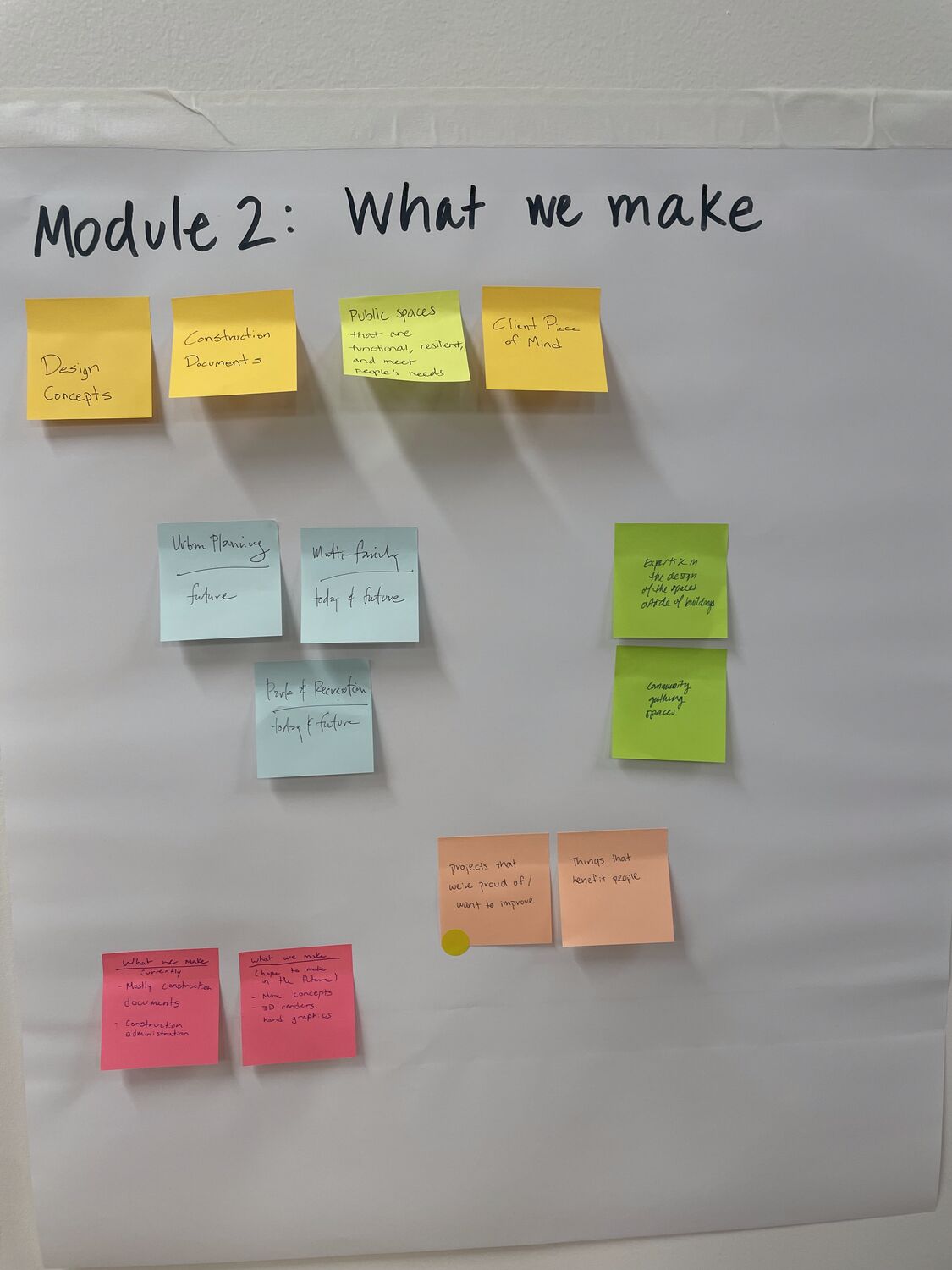
1. The "it is all construction documents" finding was wrong. That pink sticky was Cathryn describing her own job, not the firm's output: "I just did construction documentation and construction administration, and what I'm hoping to is more concepts, more 3D rendering." It is not a brand contradiction. It is a retention issue in a studio whose junior designers want design work and are getting production work. Different problem, different owner, and it does not belong in the brand platform.
2. "Private developer work means less public engagement" was Keith, not a team member. The studio director named the cost of his own growth plan, unprompted. Stronger, and safer to raise with him.
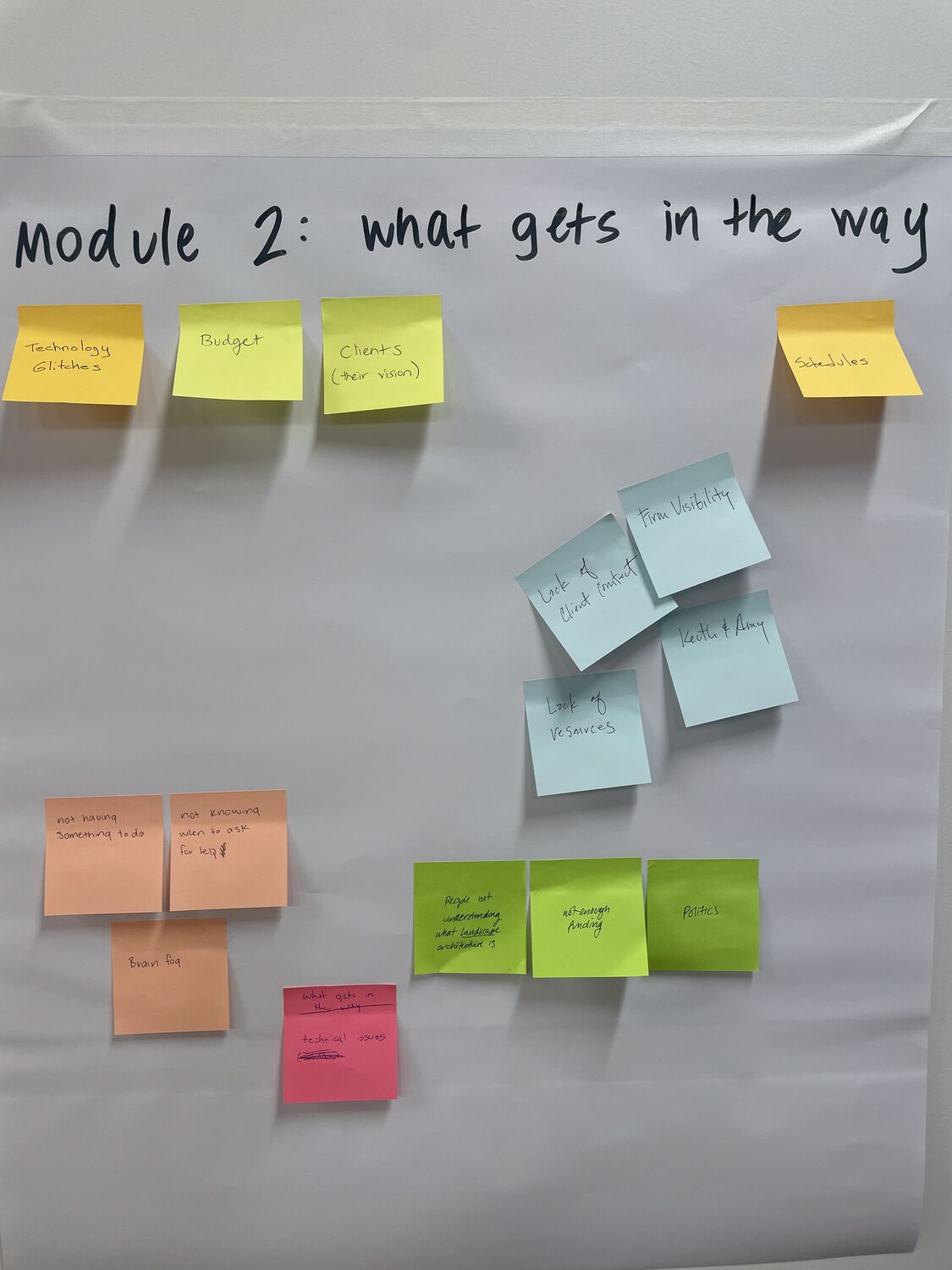
3. "We aren't the hindrance, we aren't the ones stopping the firm from growing" was Keith, not Amy. So was "ten years, I'll be seventy." Keith wrote "Keith and Amy" as an obstacle in Module 2, then in Module 4 described the ESOP as the mechanism for ceasing to be that obstacle. That is not a contradiction, it is a man naming a problem and then naming his fix. The Module 4 question I drafted got answered without anyone asking it.
Attribution is now settled. Amy is confirmed as the source of "everybody deserves a little bit of green," which the Module 3 board already records in handwriting. Sticky colors, self-references in the transcript, and the board annotation all agree. Amy's input carries as the owner and the signature on the SOW.
What we heard, what we have done, what we still need
What we heard
- The brand already exists on their own website and nobody inside the firm can say it out loud consistently. Amy has a version, Keith has a version, Monty's is technically correct and too long, Mark's is the best line in the company, and the newest designer has none.
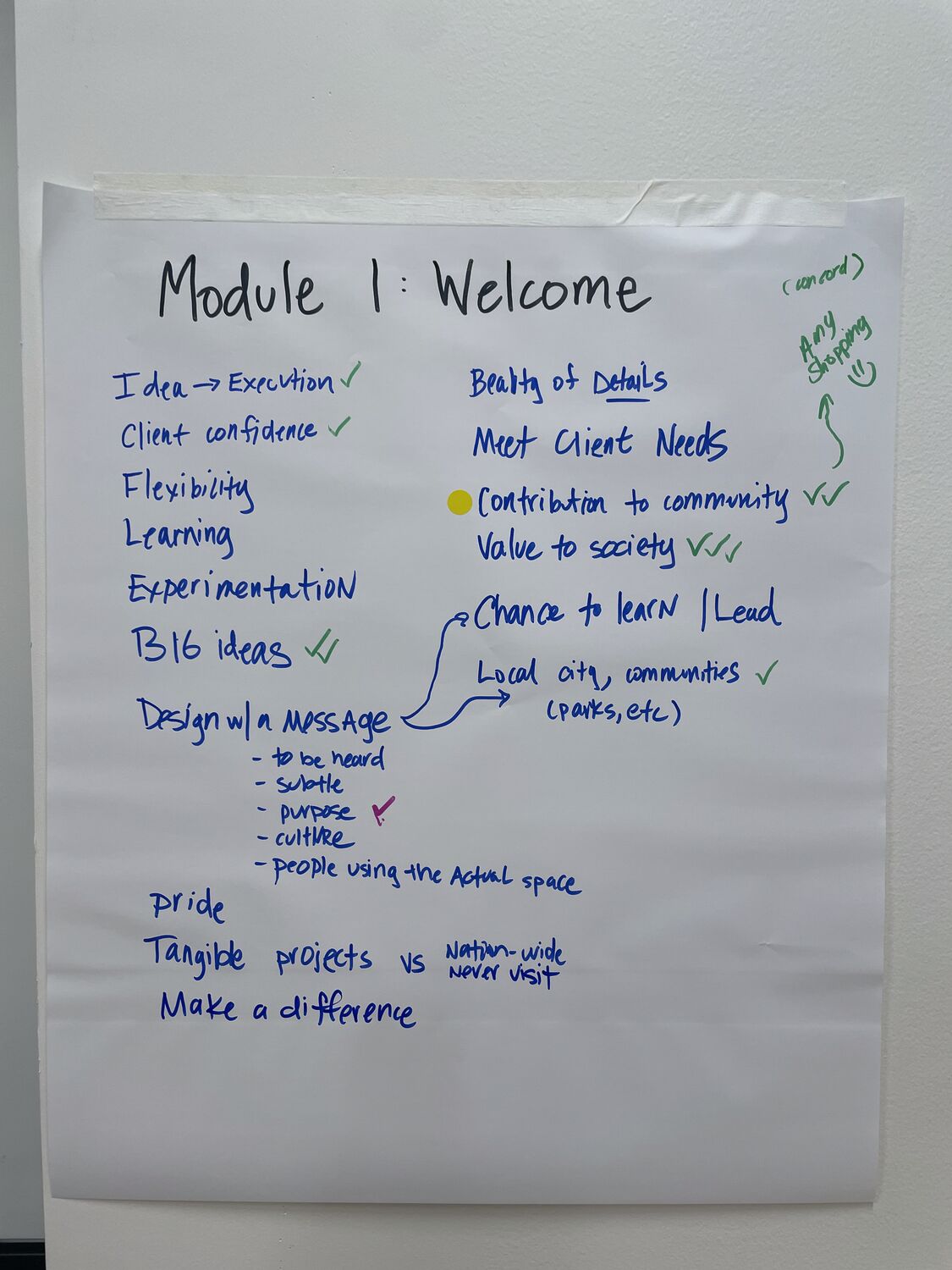
- The room is motivated by social value, not craft. Value to society took the most votes, beauty of details and meeting client needs took none, and Monty independently rejected the star-architect model.
- Amy and Keith diagnose the firm's problem in opposite places, outward and inward, and Keith has already designed his own fix through the ESOP.
- This is a de-risking plan, not a growth plan. K-12 falls from 55 percent to 15, the headcount ceiling is fixed at 15 to 20 forever, and their biggest category has already stopped producing work.
- Public work is legally competitive, so the RFP is the sales channel and cannot be avoided, yet they have it filed under money pit at a 90 percent loss rate.
- The 40th is already designed by them. Amy wants a party, Keith wants forty items not forty days, Mark wants a theme tied to place, and the team consented to being on camera with conditions.
- The passion is real and unused. Keith, at the close: "All three of them pointed out one thing that I hadn't seen. The passion that you guys bring for landscape architecture right now, we are not tapping into that."
What we have done
- Ran the all-staff charrette. Six boards, a growth matrix, a vision-in-numbers session and a 40th inspiration presentation, across four hours.
- Captured and verified the full record: three recordings, 37,000 words, ten photographs, transcribed and cross-checked against the boards and the signed agreement.
- Drafted the platform, four layers, entirely in their language.
- Audited the live site against what the room said and found the continuity argument.
- Corrected three findings that the live notes got wrong before any of it reached the client.
- Built this document and the session record for the team.
What we still need
- From CKD: the three real market-share percentages, promised by Amy within two weeks on 3 September. Customer stories, which do not exist anywhere. Candice's contact. Past award submission examples. The ASLA conference date.
- From us: the readout, the written platform, the voice guide, the 90-day roadmap, the 40-for-40 capture checklist, the LinkedIn rework and Mark's starter posts, and the SEO playbook for Candice.
The color key
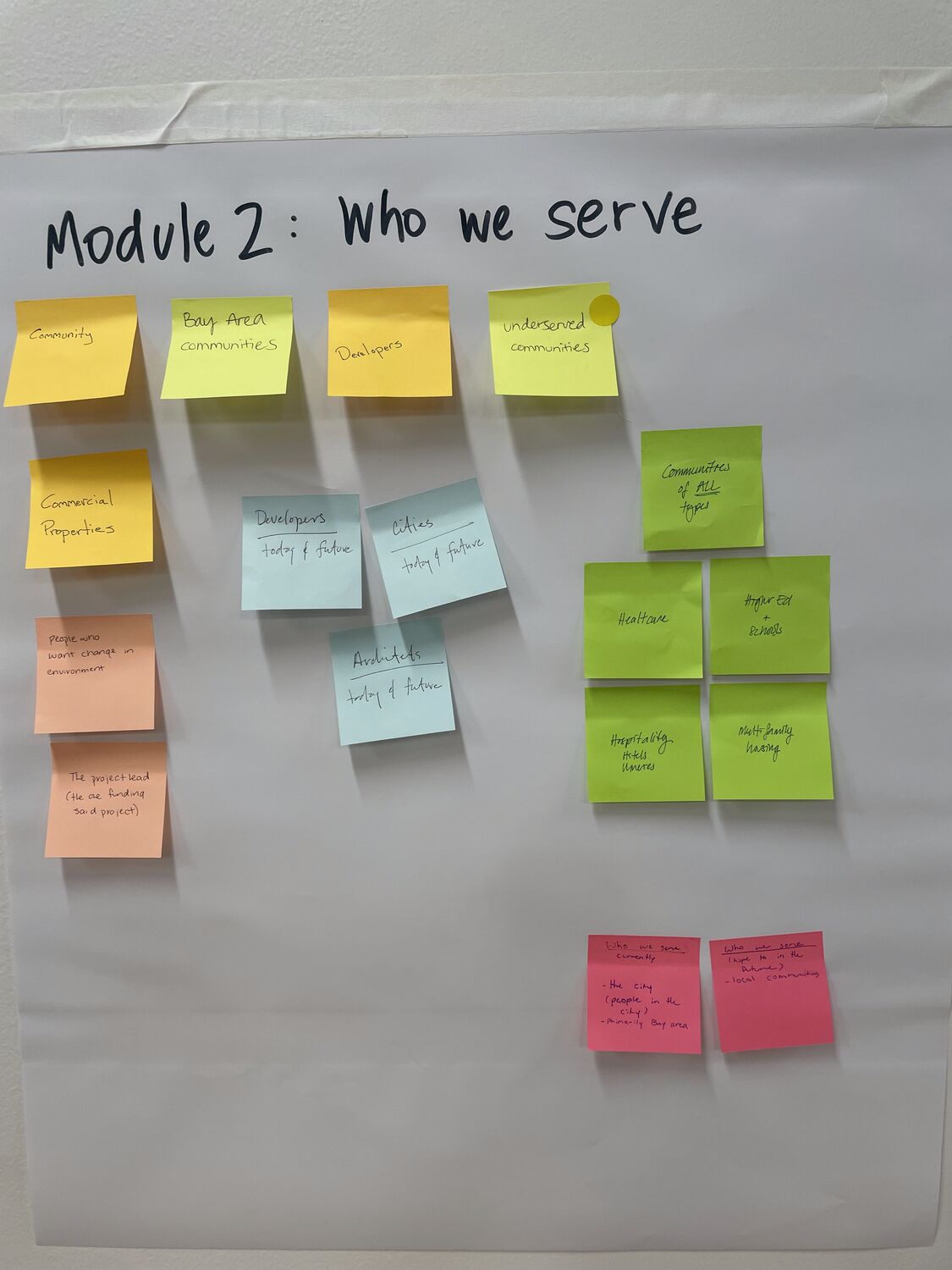
The room did not use the key in playbook v4. Green is Amy, blue is Keith. No purple was used. Yellow, orange and pink are the team, and individuals cannot be separated from the photographs, so team attribution here is aggregate.
Amy Cupples. Principal, owner, the decision maker and the signature on the agreement.
Keith Billick. Studio director, becoming partner, stepping into Amy's role over ten years.
Monty, Mark, Cathryn, and the newer designers.
Locked by the room. Three placed: contribution to community, underserved communities, projects we are proud of.
The wall and the room
Tap any image for full size.
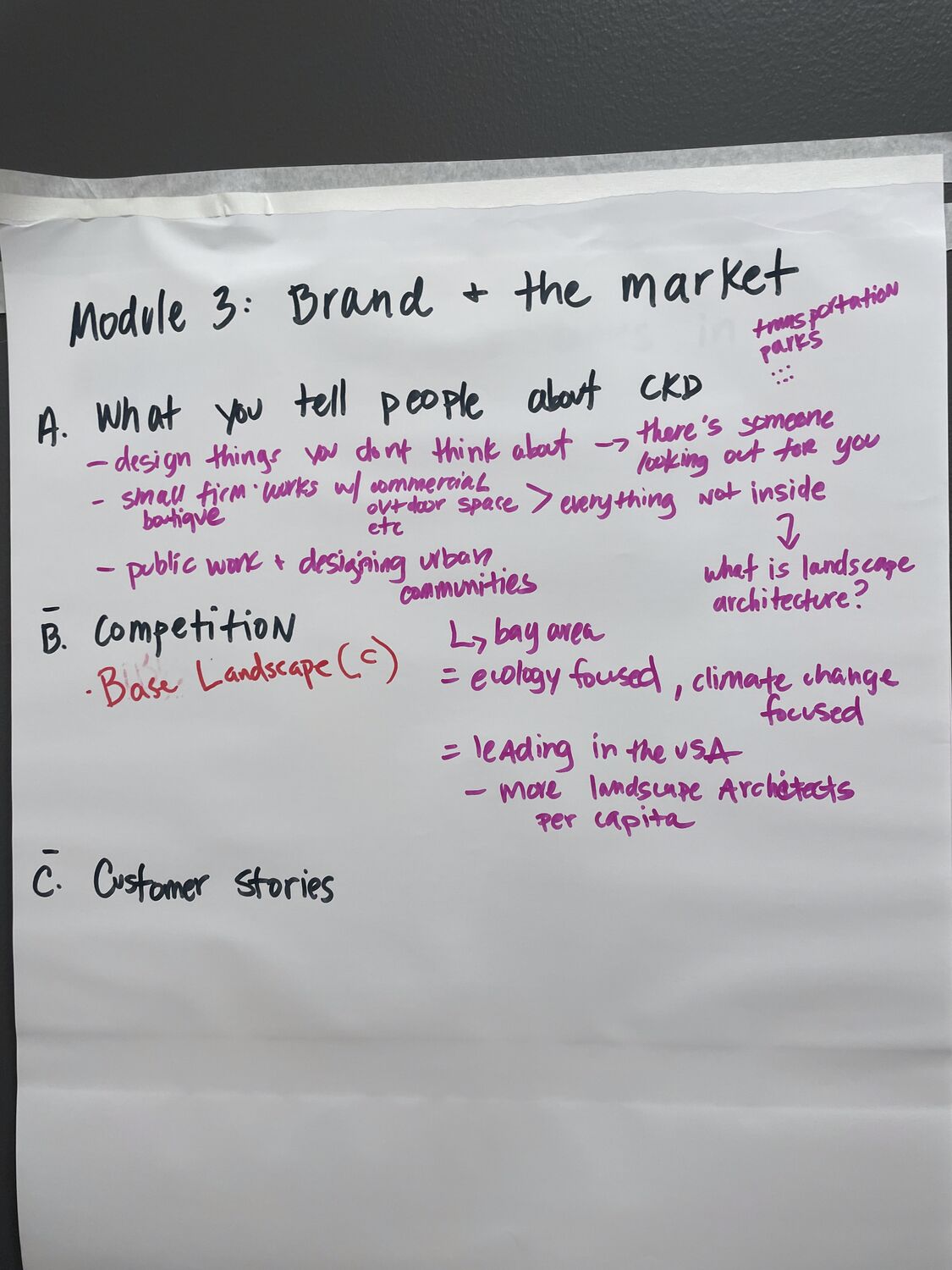
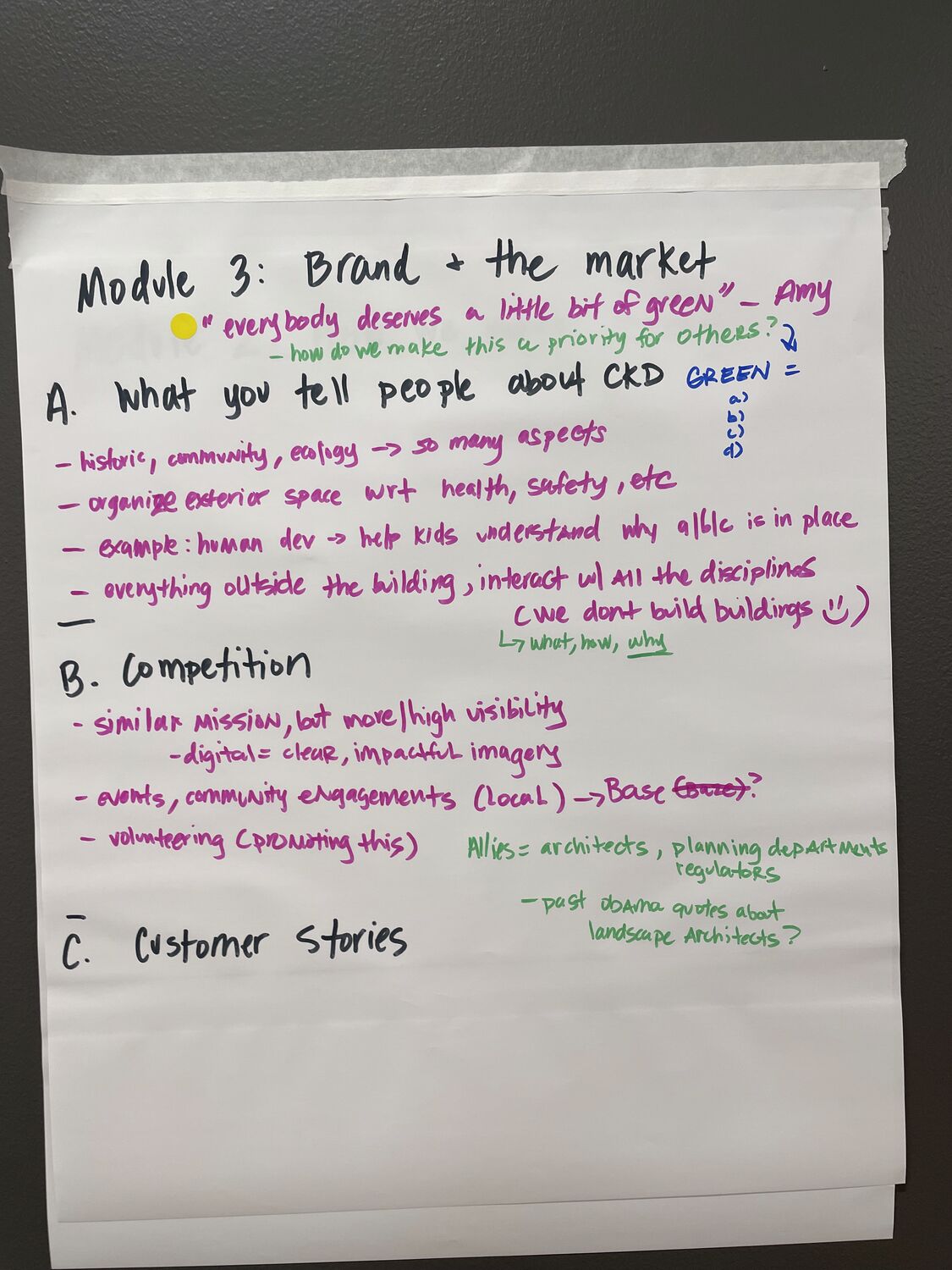
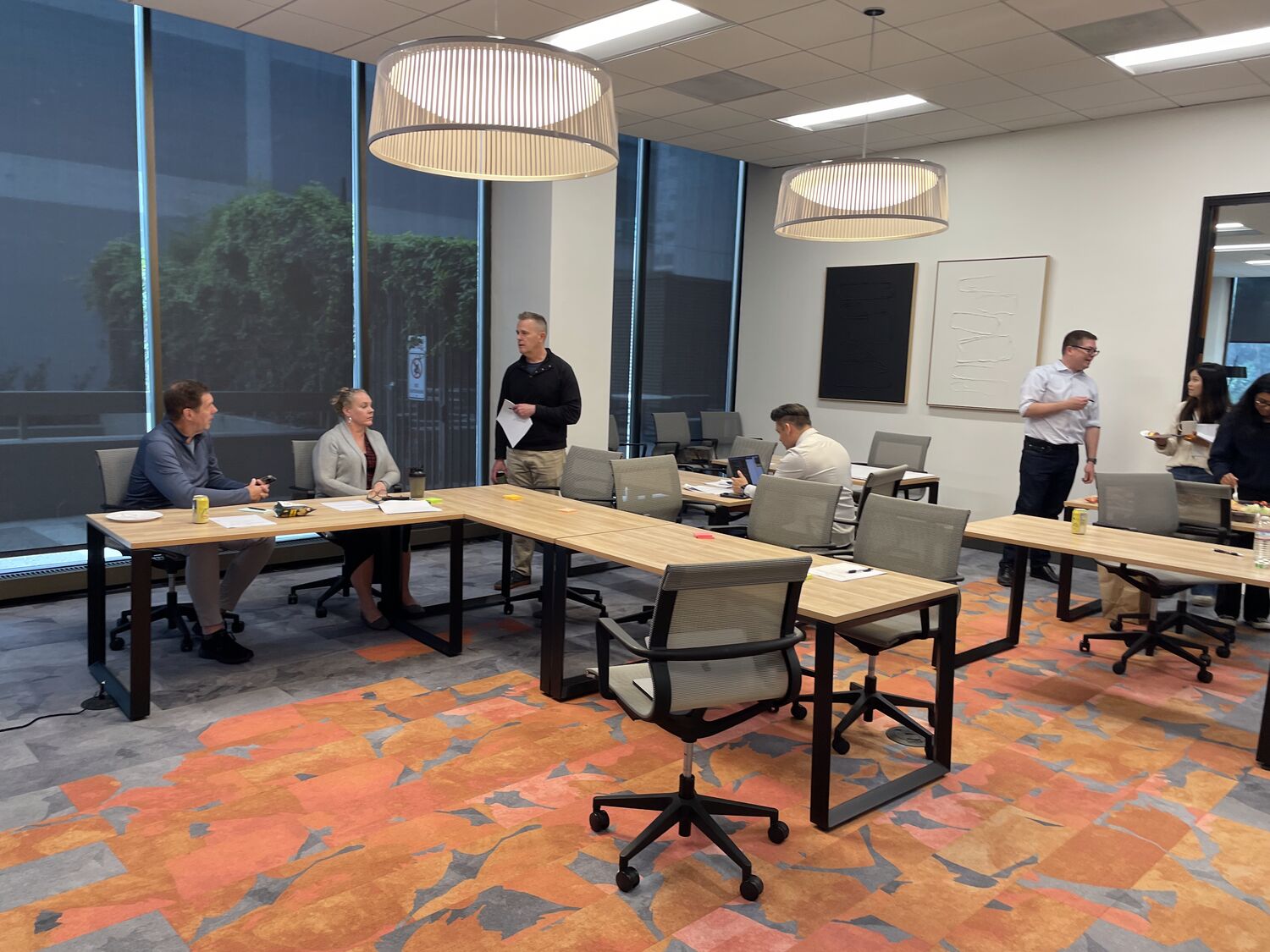
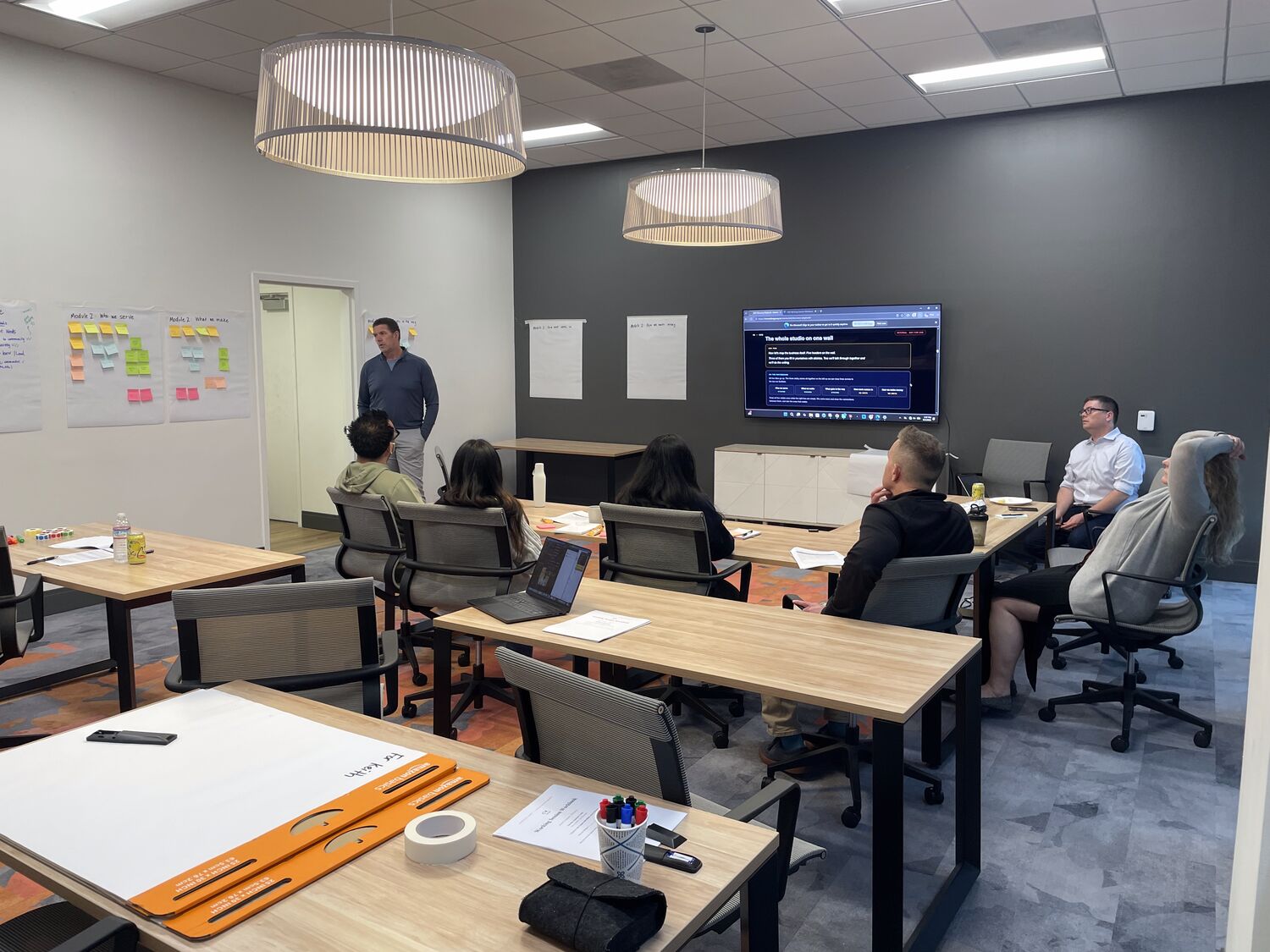
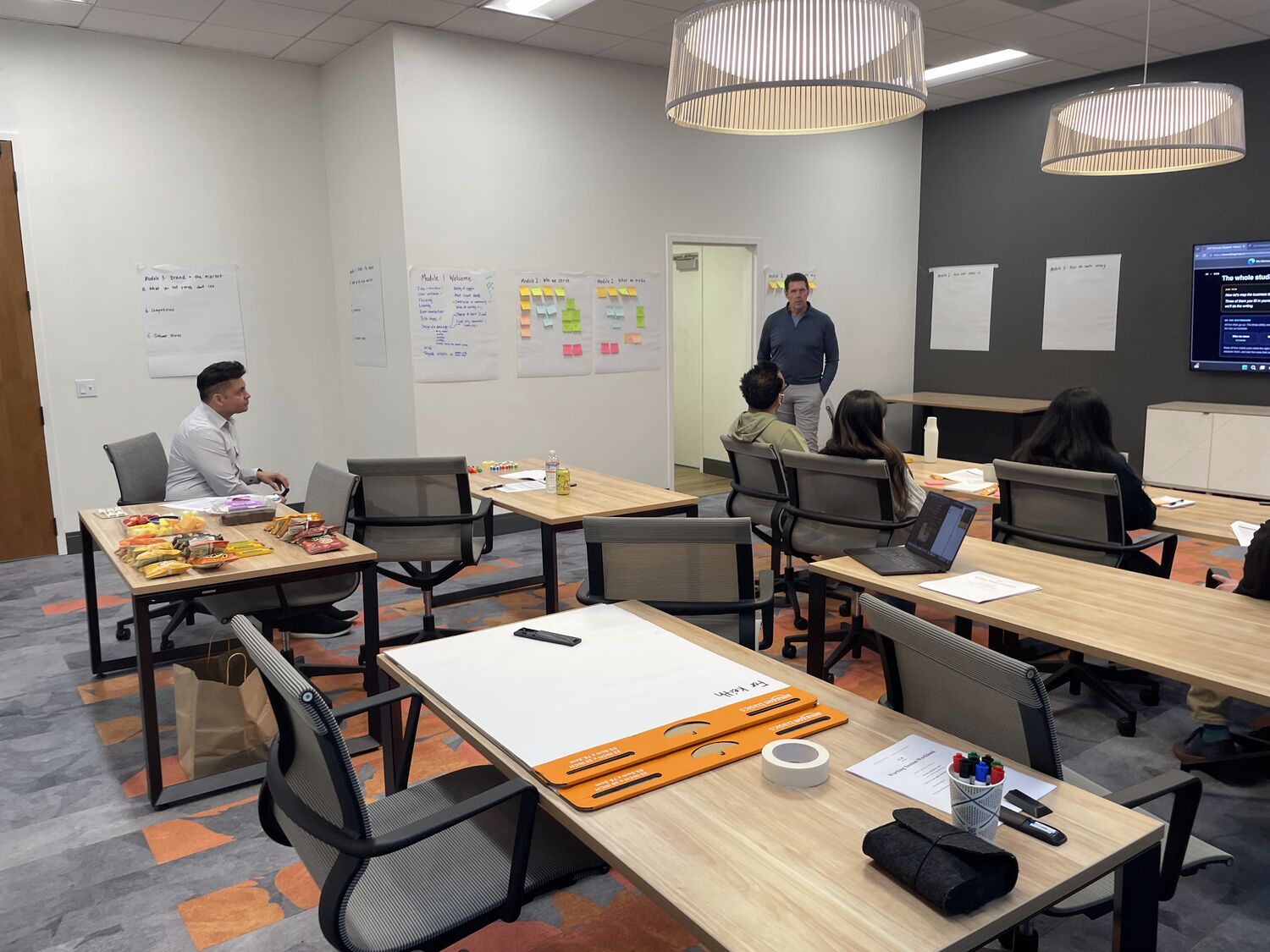
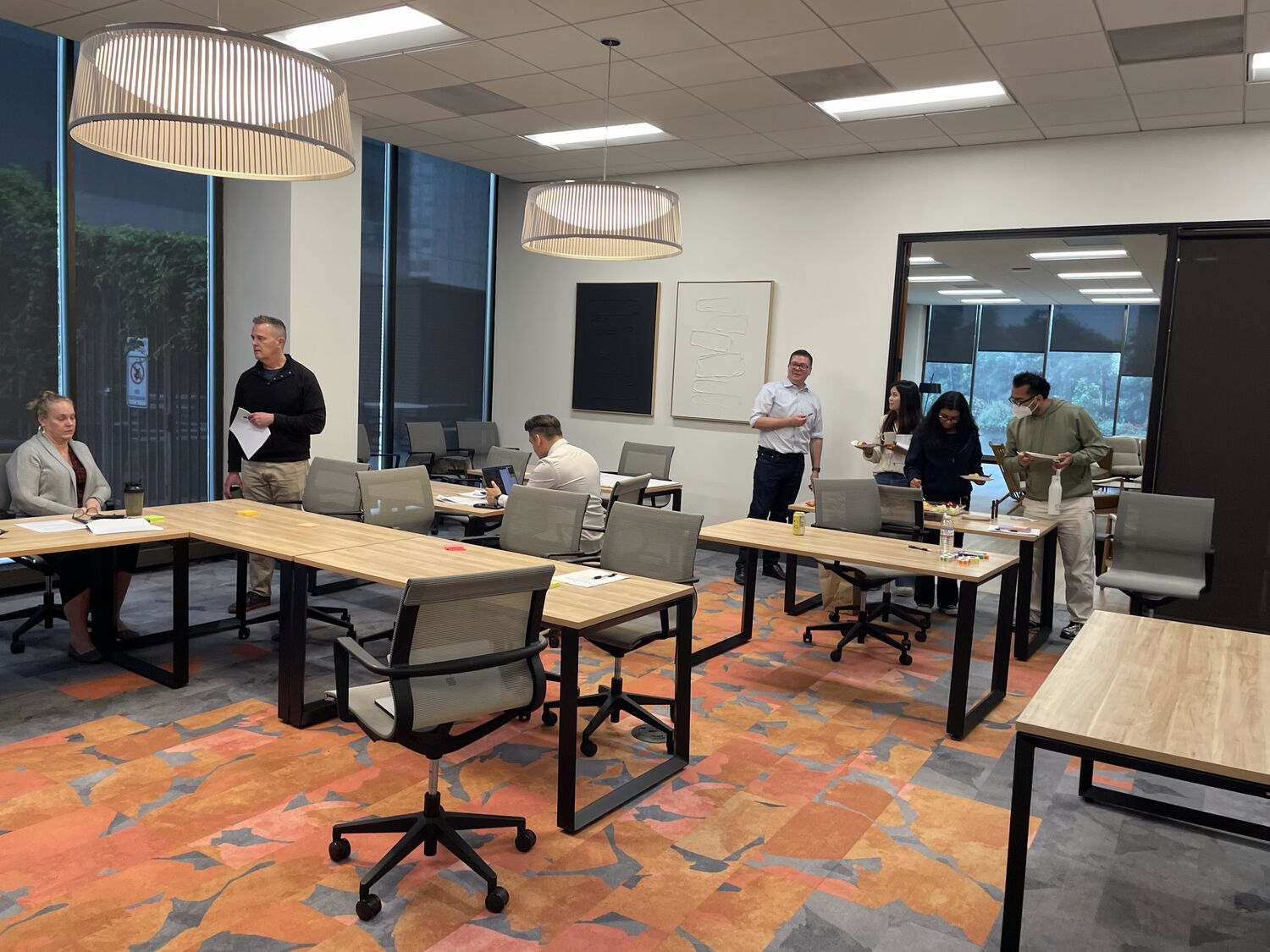
Before any of the four room shots go client-facing. Recording consent was taken at the top of the day. Publishing consent was not. Faces are identifiable in all four.
What the room voted for
Module 1 values, counted by checkmark off the sheet.
What it means
A landscape architecture studio voted social impact above craft and above service. Beauty of details took zero. Meet client needs took zero.
Monty said the same thing in words, without being asked: "I'm happy to work for a firm that doesn't have a star architect running it. Somebody with a big ego wearing a cape. It's more important in this industry to do really good, functional design that's beautiful, rather than have some unique, bespoke symbol that you leave behind as a breadcrumb of your existence."
Three independent signals now agree: the count, Monty's statement, and the vocabulary, which is almost entirely civic and almost never about craft. A portfolio-and-auteur brand, which is what most of their peers run, would feel false to their own staff.
Confidence: high on the count and on the triangulation. One caution, Amy's own founding memory is the beauty of details in a Japanese garden, so this is the team's centre of gravity rather than hers.
CKD on a Page, in their words
Who we serve
Amy Communities of all types. Healthcare, higher ed and schools, hospitality, multi-family. "Every project is community, whether it is hotel clientele or a park and neighborhood community, or streetscape or school."
Keith Developers, cities, architects, each marked today and future.
Team Bay Area communities. Underserved communities, gold dotted. The project lead, meaning whoever funds it.
Filled fastWhat we make
Amy Expertise in the design of the spaces outside of buildings. Community gathering spaces.
Keith Urban planning, future. Multi-family and parks and recreation, today and future.
Team Design concepts, construction documents, public spaces that are functional and resilient, client peace of mind.
Filled fastWhat gets in the way
Amy People not understanding what landscape architecture is. Not enough funding. Politics. All three outside the firm.
Keith Lack of client contact. Firm visibility. Keith and Amy. Lack of resources. All four inside it.
Team Budget, schedules, clients and their vision, technology, not knowing when to ask for help.
Thickest boardHow work comes in
Never made the board. Mark: "as a client, if you are informed about it, you immediately just want to go with the ones you know. It's really about who you know, who you've heard of." Otherwise second hand through developers and architects.
Thin, verbal onlyHow we make money
Covered later with Amy and Keith. See the numbers section. Monthly invoicing, a mix of hourly, lump sum and percentage completion, and a 90-day cycle on the big projects.
Recovered in Module 4Who does what
Signals only. The mentoring load sits on three people, Amy, Keith and Monty, and the experience gap is specifically between Monty and the next person down.
Thin, still owedWhat the thickness says
The three full zones are about the work. The three thin ones are about the business. This is a studio that thinks in projects rather than in a machine, which is also why marketing has never had an owner: the thing that brings work in has never been drawn.
The platform
The tagline in the SOW was never ours. studiockd.com already publishes "Designing for how people live + work together, sustainably." So the July proposal lifted their line. Telling them to retire it means telling them to drop something they already publish.
And the site already says what the room gold dotted. Amy's intro paragraph: "We are partial to projects that mitigate environmental harm, add green space to underserved neighborhoods, and meaningfully engage communities." Green space. Underserved neighborhoods. Community engagement. She wrote that before we walked in.
That is the opening line of the readout. We did not find a different company on 3 September. We found the one Amy already wrote down, and the job is getting the other seven people able to say it.
Four layers, not one line
The argument for taking "sustainably" off the hero
Amy told us herself: "the Bay Area is a bubble, and we tend to be a little bit more ecologically focused, so we have regulations that push in that direction." In this specific market sustainable is a regulation, not a position, and every competitor is pushed the same way by the same rules. It also sits in the "everyone says these" column of the peer research.
Where she is actually differentiated and has never built anything is woman-owned. Two of thirteen peer firms mention it and neither does anything with it. The site states it in passing. That is open ground she already has a legitimate claim to.
Confidence: high that "outside" belongs in the line. Medium on dropping "sustainably," because it is a values question for Amy, not only a positioning one. Offer both and let her choose. The version that keeps it: "Designing how people live and work together outside, sustainably."
The only social proof on the entire site is one testimonial praising Amy personally for a residential project. Off-strategy for a firm chasing public work and developers, and it is the only client voice they have anywhere. Module 3 Section C is blank. Customer stories just moved from nice-to-have to the thing blocking two deliverables.
The language
All of it now lives in the client-facing documents rather than here, because they are the version CKD actually reads. The brand platform and voice guide carries the four layers, the motto, vision and mission, the four audience scripts, the two stock answers, the words to own and avoid, boilerplate at three lengths and the project-description structure. The one-page card is the compressed version people carry.
Three things belong here instead, because they should not go to the client in writing.
The retention risk. Cathryn wants concepts, 3D and hand rendering and is doing construction documents. Another designer listed "not having something to do." A brand that promises design ambition to the outside world while juniors do production inside will not hold. Say this to Amy and Keith privately, never in the room.
Engage. Entice. Enrich. CKD's existing three words. Across four hours and 37,000 words on 3 September, nobody said them once. We are recommending they move to a how-we-work page rather than retire, but the fact that nobody uses them is worth knowing before Amy is told her three words are being demoted.
Why the voice guide is operational, not decorative. Keith will not send staff to ally events until they can explain the firm: "we don't want them just go there and eat the snacks and drink the drinks and then go home." The guide is what converts ally events from a cost into the easy win they scored it as. Use that line in the readout, it makes the deliverable feel like a tool.
Where they split, and what got answered
1. Amy looks outward, Keith looks inward
Every one of Amy's obstacles is outside the firm. Every one of Keith's is inside it, and one of them is the two of them. They wrote in silence, so neither heard the other.
This one resolved itself. In Module 4 Keith described the ten-year plan as the mechanism for ceasing to be the obstacle: "through the ESOP, through the growth of the firm, we build leadership up that allows me to still be involved, allows Amy to still be involved, but to the point of what gets in the way, we aren't the hindrance."
So both are right about different things, and the consequence for us is the useful part. Amy's diagnosis is a market awareness problem, which makes marketing the primary lever rather than something downstream of an internal fix. She is the owner and the signature. That is the strongest renewal argument in the file.
2. Underserved communities against the growth plan
The room gold dotted underserved communities. Keith wants two or three regular developers to become ten or twelve, and he named the cost himself: "as we start working for developers, private developers, there's less public engagement, less public involvement."
Monty already solved it with a CKD project. On Willow Shopping Center in Concord: "there were play areas there that you didn't have to go shopping to enjoy. You could use it just as part of the community without shopping." Public value delivered inside private development, in their own voice. That is the bridge, and it is a case study waiting to be written.
Amy's framing closes it: every project is community, hotel clientele included. Keith's warning becomes a condition to manage, not a veto.
3. The staff want design work and are doing production
Cathryn: "I just did construction documentation and construction administration, and what I'm hoping to is more concepts, more 3D rendering, show our creativity." She wants Lumion, hand rendering, a touchscreen. Another designer listed "not having something to do" and "not knowing when to ask for help."
Meanwhile the principals say the bottleneck is that they cannot delegate without handholding. Those are the same problem seen from both ends. It is a people issue, not a brand one, but it will decide whether the brand survives contact with the next two years.
4. Two things nobody followed up on
Amy said she has "another project that I'm working on" when asked about ten years out, and it went straight past. A principal with a side project during a succession plan is worth understanding.
And Keith will be seventy in ten years. If he is the bridge to the ESOP rather than the destination, the brand has to carry further than one handover.
The vision, in their numbers
From Keith's accelerator deck, shown on screen in Module 4, with Amy's corrections applied.
| Now | Next 3 years | Next 10 years | |
|---|---|---|---|
| Revenue | ~$1.25M | ~$1.75M | ~$2.25M |
| Headcount | 7 | 10 | 13 |
| Services | Landscape architecture | Landscape arch and planning | Landscape arch and planning |
| Locations | Oakland | Oakland and SF | Oakland and SF |
| K-12 education | 55% | 35% | 15% |
| Multifamily | 10% | 25% | 25% |
| Parks and recreation | 25% | 10% | 10% |
| Municipal | 10% | 20% | 20% |
| Private development | — | 10% | 10% |
| Master planning | — | — | 20% |
| Ownership | S Corp, single owner | S Corp, partnership | S Corp, ESOP |
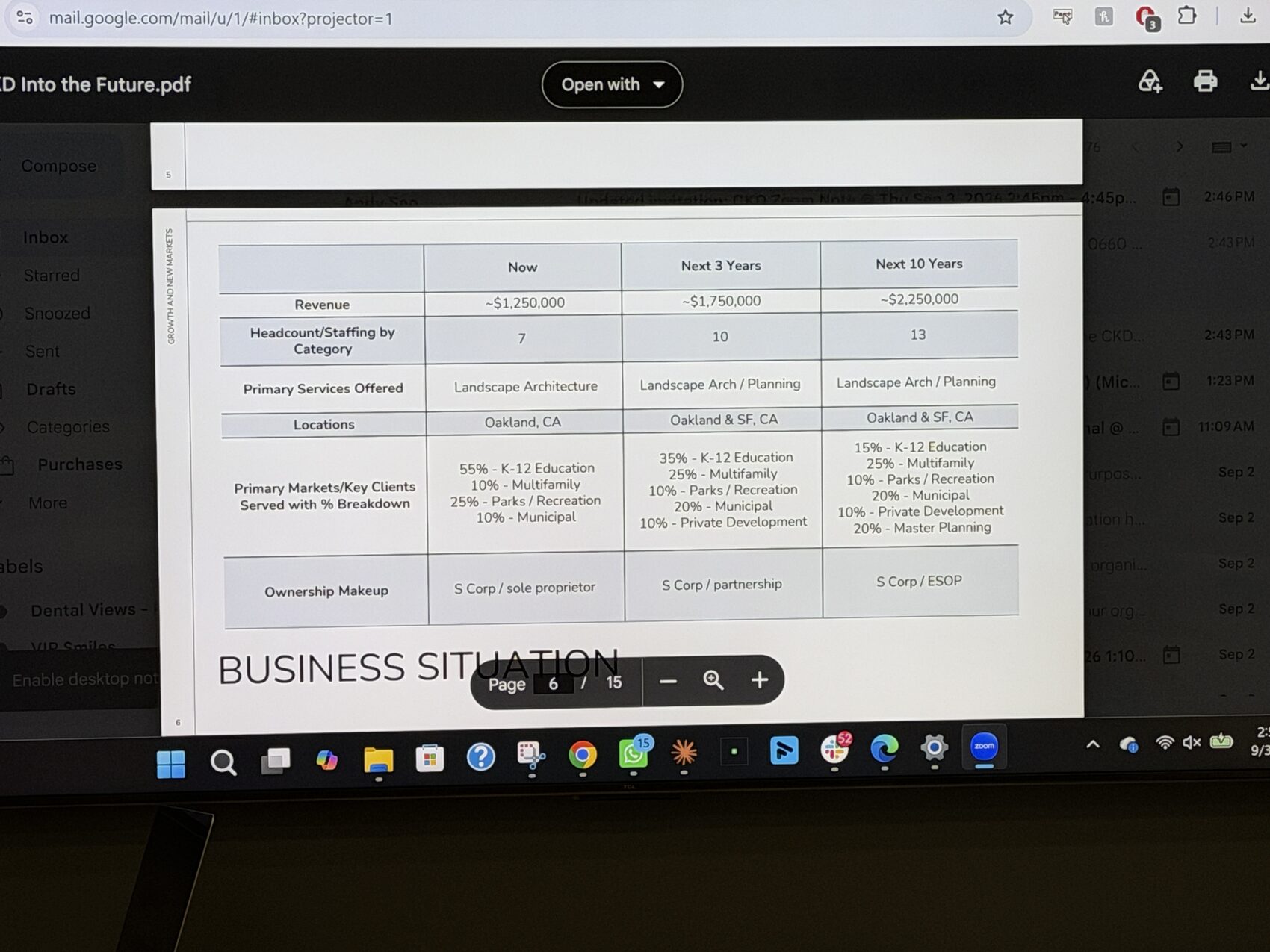
Amy's corrections, on the record
- $1.25M would be a record and they will not quite hit it this year. "That would be a record high, but I think we're going to come pretty close." All three revenue figures she called "a little bit on the high side."
- They have doubled revenue since 2021, but 2021 was the heart of COVID, so the base is soft.
- Headcount ceiling is 15 to 20, ever. "No more than 15, 20 as a maximum, absolute maximum."
- Keith built the deck. "Amy had no input into this," other than past conversations.
- Amy owes the three real market-share percentages. She said "give me two weeks" on 3 September, so they are due about now.
What the numbers actually say
This is not a growth story, it is a de-risking story. K-12 falls from 55 percent to 15 while five other categories rise. Amy: "right now we are somewhat heavy in one realm, and the idea is that over ten years we are much more equally balanced, so we don't have all our eggs in one basket." Revenue roughly doubles over a decade while headcount barely does, and the ceiling is fixed. A firm deliberately rebalancing its book while staying small on purpose is a more honest and more interesting story than growth.
The timing is not theoretical. "We're just finishing up a bunch of education projects, and we have no education projects right now. No new clients, no school districts, because they don't have money." Their largest category has already stopped.
Capacity, and the real constraint
- Roughly 38 to 40 live projects. Forty has been the run rate for about a decade. One more senior hire is what it takes to exceed it.
- Three of the forty are big, each half a million or more in fee over several years, together about 40 percent of revenue.
- Keith's stated target is 30 percent in big projects and 70 percent in mid and small, for cash flow. They are currently above their own threshold.
- Big projects run a 90-day payment cycle. Smaller work is what keeps the monthly billing steady.
- The bottleneck is senior time, not demand. Amy, Keith and Monty carry the mentoring and all three enjoy it. "It's just too much."
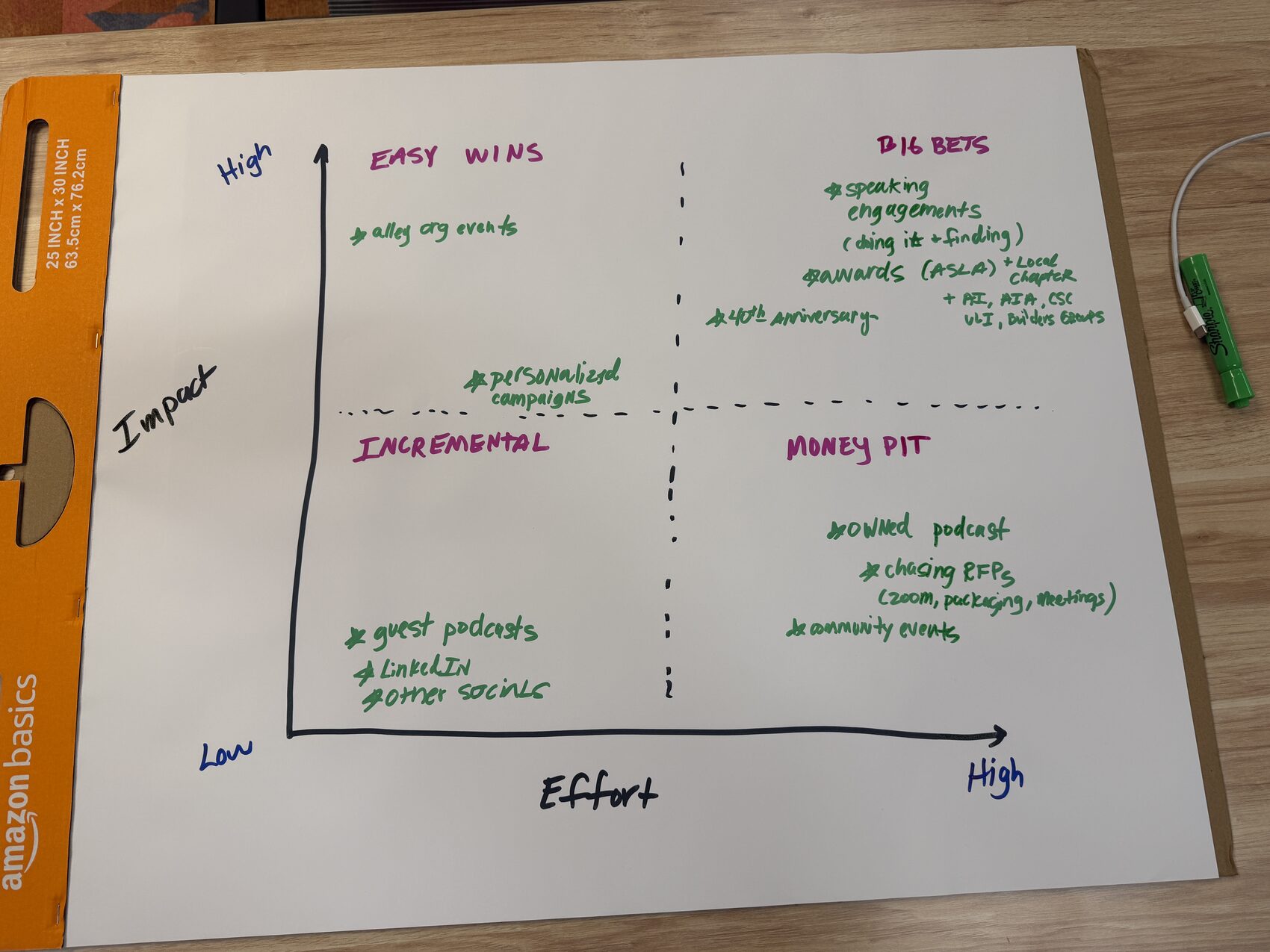
The growth matrix
Module 5, Amy and Keith only. Their placements, not ours.
The finding that should lead the readout
"Public agencies, with public money, have to go through a competitive process. They can't sole source. So we could be strongly recommended, but ultimately it still would be a competitive process."
Now put that against their own matrix, where chasing RFPs sits in the money pit, at roughly a 90 percent loss rate when they have no prior contact, with 8th Street costing December to June for a half-million-dollar project.
They cannot stop chasing RFPs. For public work the RFP is the sales channel, by law. So the money pit is not optional, which means the only available move is to make each chase cheaper and more likely to win. That reframes their worst quadrant into a fixable cost, it is measurable, and nobody has put it to them. It is the most commercially serious thing in the session.
Two placements that need a condition attached
Ally org events are only an easy win if Amy and Keith go. Keith: "If Amy and I went to those, there's no effort on our part, and high impact. If it's staff going to it, I think there's a little more effort that needs to go into it." He does not want staff who "go there and eat the snacks and drink the drinks and then go home."
That is exactly what the messaging and voice guide is for. Deliverable A is what converts staff attendance from a cost into an easy win. Say that in the readout, because it makes the guide feel operational rather than decorative.
Community events were parked in the money pit, and Keith attributed the idea to Cathryn by name. If the recap celebrates community and the team sees their idea was killed, that stings. Separate hosting community events, agreed money pit, from community engagement inside projects, which they already do and which is the brand.
What is missing from the board
- Referrals and repeat clients, which is actually how most work arrives, never got plotted.
- Award submission production, the renders, diagrams and imagery, which is the real cost of the awards big bet and the thing we can absorb.
- The website, already in progress with Candice.
- The newsletter to the education base, which Chris floated and nobody plotted.
- Amy's jam jars. She cans preserves, they labelled them for CKD and dropped them at architecture and engineering firms at the holidays. Boxes from last November are still sitting in the office undelivered. Low effort, real warmth, and the most CKD thing on the list.
Where the SOW stands
Signed 12 August by Amy as CEO. $7,500, three payments of $2,500. Term about eight weeks, August through October. We are past week five.
Nothing has been sent to CKD. Three documents are written and live but unlisted. Invoice two of three is due around now. See Needs our attention for the detail.
A and D are unblocked and are most of the remaining contracted value. Do those first, in that order.
Delivery plan and the closing exercise
Ship order
- The readout. Written and live → Opens with the site finding, then the drift chart with all six pitches verbatim. Ready to send.
- Brand platform and voice guide. Written and live → Built on the four layers above, plus the voice guide for all four audiences.
- The 90-day roadmap and website playbook. Written and live → Includes a real audit of their Squarespace site.
- LinkedIn and a starter post batch for Mark. Written and live → Company page copy plus twelve posts, one a week for a quarter. Still need the ASLA date from Amy, because if it is close this jumps the queue.
- Reach Candice. Deliverable B cannot close without her.
Every person's actual elevator pitch from 3 September, side by side, Amy down to the newest hire, verbatim.
Amy has one. Keith has one. Monty's is accurate and he says himself it is "too broad" for an elevator. Mark, six months in, produced the best line in the company. The newest designer said "I don't really have a good explanation or understanding of the projects either, so I'm just trying my best." That single slide justifies the entire engagement and it is one hundred percent their own words.
The closing session, reframed
This changed on 17 September and the change matters. It is no longer a readout. The readout happens first, virtually, with Amy and Keith alone. By the time the studio is back in the room everything is already agreed, which means the session stops being a presentation and becomes enablement. Michael: "this is what we agreed to, here are all your ideas, we solidified it, we got approval, and this is what we're moving forward with." Chris: "now let's go put it into action. Lights, camera, action."
The mechanism is Andy's. The team gets the one-page card in advance, and the session is where they practise using it, answering as if we were a prospective client. That turns an hour of being talked at into an hour of rehearsal, and it is the only version of this that survives contact with eight busy people.
Short. Their words on the wall, then the four lines. Credit Mark and Monty by name.
In pairs, then to the room. We play the prospective client and ask the three questions they get asked every time. This is the bulk of the session and it is the part that changes behaviour.
The "GREEN =" list on the board still has four empty slots. Fill them with the room, in their words.
Not a request into the air. Assign, and put a date on it.
Where this is all pointing, and what happens next.
Chris's flag, still open. "I think this is all kind of boring and I wouldn't leave with any wow." The agenda above is serviceable rather than memorable and it needs a proper brainstorm before we propose it. Two constraints for whatever we invent: it cannot put anybody on the spot in front of a camera, and it has to end with the team feeling they own the words rather than received them.
Consent is already conditionally given for the camera. Keith confirmed nobody has to use the same medium. Written is acceptable, voiceover is acceptable, Michael offered five seconds on screen with B-roll over the rest, and Andy offered a two-person conversational format. Mark asked for a theme that ties the stories together, and Keith endorsed it.
The yearly plan
Amy and Keith only. This merges their numbers with our marketing arc. It contains capacity, succession and revenue detail that should not go to the wider team. Keep it here, and present it in the principals-only portion of any session.
| Year | Their business | What marketing has to do | The test at year end |
|---|---|---|---|
| 2026 now |
Just under $1.25M, a near-record. Seven people. Roughly 40 live projects, 3 of them big and carrying about 40 percent of revenue. K-12 at 55 percent and already gone quiet. | Foundation only. Brand platform, voice, LinkedIn, the 90-day roadmap, the 40-for-40 capture kit. Get the studio saying one thing. | Every person can give the same ten-second answer. The site hero has changed. Customer stories exist. |
| 2027 | Toward $1.75M. Hire the one senior who closes the gap under Monty. Keith formalised as partner. Private development and multifamily start to show. | The 40-for-40 campaign runs. Awards submitted in February and announced through the year. Speaking submissions on a schedule. ABM list built and the first developer targeting runs. | At least one award in hand. Forty items captured. Two or three new developer relationships that did not come from an RFP. |
| 2028 | The 40th. Ten people. Mix approaching the 60/40 the June plan set. Master planning starting to appear. | The anniversary moment. The party Amy asked for, the book, the event, the press. Everything from 2027 compounds into it. | CKD is on shortlists it was not on in 2026, and can point to why. |
| 2029 to 2036 | Toward $2.25M and 13 people, with a hard ceiling of 15 to 20 ever. ESOP in place. Amy advisory. Keith into Amy's role. K-12 down to 15 percent, master planning at 20. | Sustaining, and increasingly run in-house. The brand has to survive two handovers, so it cannot be built on either principal's personality. | The firm is legible without Amy in the room. |
The strategic point to make to them. Their own numbers describe a de-risking plan, not a growth plan. Revenue roughly doubles over a decade while headcount barely does and the ceiling is fixed. K-12 falls from 55 to 15. That means marketing is not being asked to generate volume. It is being asked to change the composition of the pipeline while the total stays modest. Those are very different jobs and most agencies would sell them the wrong one.
Two numbers we still do not have, and both change the plan. Margin by project type, which Amy said is "getting better" but never quantified. And the real market-share percentages, which she owes us within two weeks of 3 September. Without them the 2027 targeting is guesswork.
Timeline
Contracted term runs August through October. Everything after that is the renewal arc.
| When | What | Note |
|---|---|---|
| This week | Call with Amy and Keith | Talk track below. Close on the three asks and book the closing session. |
| This week | Readout delivered, portal link sent to the whole team | Includes the anniversary mood board Chris promised the room on 3 September. |
| This week | Candice contacted | Unblocks deliverable B. |
| Next week | Brand platform and voice guide drafted | Deliverable A. The largest remaining contracted item. |
| Next week | LinkedIn rework and Mark's starter posts | Pull earlier if ASLA is imminent. |
| Week after | 90-day roadmap | Deliverable D. Their matrix re-sorted, with owners. |
| Early Oct | The closing session, 75 minutes, whole studio | Playback, pitch test on camera, define green, assign customer stories. |
| Mid Oct | 40-for-40 kit and the website page refresh | Deliverables C and B. Kit needs the customer stories from the closing session. |
| Late Oct | SEO playbook, hand-off, final invoice | SOW complete. Renewal conversation opens here. |
| Nov to Dec | Award project selection and submission build | Renewal play two. Choose projects, commission the renders and diagrams. |
| January | ASLA call for submissions opens | Hard external date. Also AIA, CSI, ULI, builders' groups. |
| Late February | ASLA national and chapter submissions due | The forcing function for the whole renewal. |
| 2027 | 40-for-40 campaign runs | Per the SOW. Fuelled by any awards announced through the year. |
| 2028 | The 40th anniversary | Amy wants a party. |
Outreach, and the client-quote request
Two emails. The first goes from Andy to Amy with Keith copied, rewritten again after the 24 September call. The second is for Amy or Keith to forward to clients.
1. The email to Amy and Keith
Amy, Keith,

Thank you both again for 3 September, and for putting the whole studio
in the room. Most firms send two people. It changed what we got out of
the day, and a lot of what we are bringing back came from people who
have been at CKD under a year.

We have built out everything we committed to in the agreement and it is
ready for you here:

[portal link]

One thing worth saying before you open it. We did not come out of that
room with a new company. The clearest line we found is already on your
website, Amy, and you wrote it. The work now is getting the other seven
people able to say it the same way.

The first thing on that page is your mission statement. Under it are
your vision, what you believe, your positioning line, the version
everyone in the studio should be able to say out loud, and the version
for proposals. Two of them have a choice attached, because there was a
real judgement call and we would rather you made it than we did.

Under that is the agreement itself, broken into every line item, with
where each one stands. Eleven are done or waiting for you to read,
three need something small from you, and two we are holding on purpose
until we have talked about timing.

No obligation to read any of it beforehand. We will walk you through
the whole thing on Wednesday, and honestly the only decision we really
need is which version of one sentence you prefer.

If it helps, here is what we are covering and roughly how long each
part takes:

[meeting link]

Wednesday the 30th at 10 is in the diary. If that has stopped working,
anything later that week is fine and we will fit around you.

Andy
Why it is built this way, after the 17 September call. It opens with the thank you Michael wanted first. It uses the site finding to turn a reveal into recognition. It names the four lines so Amy arrives knowing there is a mission statement waiting, which is the thing Michael thought might actually make her read it. It explicitly removes the obligation to pre-read, because the risk with Amy is not disinterest, it is that the volume feels like homework. And it offers alternative dates, per Andy. The delay is not mentioned at all, because leading with an apology makes the work look late rather than thorough.
2. The client-quote request, for Amy or Keith to forward
The single biggest hole in the engagement is that no client has ever said anything we can quote. If Amy and Keith have to compose that ask themselves it will not happen. This is written so they can forward it in ten seconds, changing only the first name.
Hi [name],

We are doing a piece of work on how CKD describes itself, ahead of
our 40th in 2028, and I have realised something slightly embarrassing.
In thirty-eight years we have almost never written down what our
clients actually say about working with us.

So, a small favour, and please keep it to two lines.

When you think about working with us on [project], what stands out?
Or if it is easier: was there a reason you picked us, or kept us on?

I am not after a polished testimonial. The unvarnished version is
more useful, including anything we could have done better. If you
would rather say it on the phone than write it, even better, and I
will take notes.

Thank you,
[Amy / Keith]
Why it is built this way. Naming the gap honestly gives the recipient a reason to help. "Two lines" removes the effort objection. Inviting criticism is what makes the positive answers believable, and it is also how you find out something you did not know. The offer to take it by phone matters, because the clients most likely to say something useful are the least likely to write an email.
Send it to five. Three replies is a full section of the brand platform and the client-story half of the anniversary kit. Good candidates from the session: the 8th Street relationship where CKD sits in the city meetings, Mountain House, and whoever at the district commissioned Fremont High.
The call with Amy and Keith
Who takes what, agreed on the call. Michael opens and runs the brand foundation, which is the bulk of it. Chris and Andy take B, C and D in rotation, and Andy can take the website and LinkedIn piece specifically. The reason to split it rather than have one person present is that it makes three people visibly working on the account, which is worth something going into an October renewal conversation.
For the time, the energy, and for putting the whole team in the room. Most firms would have sent two people. Say it first and say it plainly, because it is true and because it is the reason the session produced anything.
Two minutes on 3 September, then straight into the words. Do not narrate the workshop. The portal shows the agreement and the status against it, and that page does the "here is what you bought" work without anyone having to say it out loud.
Mission, vision, belief, positioning, explainer, descriptor. Top of the portal, no scrolling. Two of the six carry a genuine choice and those are the ones to spend time on. Everything else can be a nod. This is the priority for the meeting and the rest gives way to it if it runs long.
Not a walkthrough. Where each stands, what is waiting on them, what is held on purpose. Andy takes website and LinkedIn. Frame the Candice ask as taking work off them: we hand her everything, or we do it. The 40th is a timing question we want to answer together, not a deliverable we are behind on.
The line, two or three client remarks, an introduction to Candice. Then the closing session with the studio, which is enablement rather than another workshop. Andy's framing is the one to use: they get the one-pager in advance and practise saying it as if we were a prospective client.
Briefly, and only if the first five landed. The pitch and presentation angle is the one to lead with, because the elevator pitch they just approved is literally the first thirty seconds of an award presentation. Then awards with a February deadline. Say honestly that some of it is worth doing and some is not, and let them pull.
The October arc, agreed 24 September. This call is deliverable A. A follow-up meeting mid October covers whatever B, C and D need and is where the next phase gets discussed properly. The proposal goes out and gets signed before the end of October, so the new engagement starts in November with no gap. CKD pay through October, so a November start means the revenue is continuous rather than resuming. That is the whole reason for the dates.
The one beat that matters most
Open the content portion with recognition rather than revelation. "The clearest line we found is already on your website. Amy, you wrote it. What the session showed is that nobody else in the studio can say it the same way." That turns a potentially uncomfortable reveal into confirmation, which is what a 38-year owner needs to hear.
Then, if there is room, read back three of the actual answers to "what do you tell people CKD does": Amy's, Mark's, and the newest designer's "I don't really have a good explanation." Then stop talking. Credit Mark by name, because it tells them that opening the room to the whole studio paid for itself, and that is the argument for the closing session before you ask for it.
Do not say
- Nothing about the "Keith and Amy" sticky. Keith resolved it himself in Module 4 by describing the ESOP as his own fix.
- Do not describe community events as killed. Separate hosting events, which they parked, from community engagement inside projects, which is the brand.
- Do not raise the retention issue as a finding. Offer it as an observation if the conversation goes there naturally. It is outside scope and it is sensitive.
- Do not say "rebrand." Not once. The site proves continuity.
If Amy pushes back on dropping "sustainably"
Make the answer hers: "You told us the Bay Area is a bubble and the regulations push everyone the same way. If every firm here is compelled to be sustainable, it stops being a position. Where you actually stand alone is woman-owned, and your site mentions it once and builds nothing on it." Then offer the version that keeps it and let her choose. Do not win this one on the call.
If they ask what this is costing
Nothing beyond the signed $7,500. Everything shown is deliverable A, B and D. Say it plainly, because it removes any suspicion that the extra depth is a setup for a bigger number.
Against what we set out to do
Cross-referenced against the June strategy plan on the portal, the signed SOW, and the objectives Michael set in the playbook.
The session graded against our own objectives
| What we said we needed to learn | Got it | Detail |
|---|---|---|
| The real business: revenue mix, project types, how work comes in, win rate, margins, capacity | Most | Mix, types, capacity and win rate all landed. Margins did not. "How work comes in" is qualitative only, no numbers behind the relationship claim. |
| The brand truth: what clients value, the words CKD owns, where the story undersells | Partial | The words are the strongest output of the day. What clients actually value is completely missing, because Section C never got run. |
| The competitive ground: who they win and lose against, and the open lane | Thin | Only Base Landscape named. None of the six Tier-1 firms from the June plan were tested in the room. The open lane did emerge, woman-owned plus the anti-starchitect position, but by accident rather than by design. |
| The people: three generations, the lean team, who does what, the next chapter | Yes | Overdelivered. The succession, the ESOP, the experience gap under Monty, and the retention risk all surfaced. |
| Raw material for the four deliverables | Three of four | A, C and D are well fed. B has nothing, because it needs Candice and a site audit, neither of which was on the agenda. |
What we promised to give back on the day, and did: a picture of their own business on the wall, a beyond-marketing lens on growth and capacity, and energy and pride. The close delivered the last one emphatically. What we promised and have not yet given: the same-day CKD on a Page, the first positioning line and the prioritised move list. All three exist. None have been sent. That is the overdue readout.
Where the room converged on the June plan without being led
The most reassuring thing in the whole review, and it should be said to Amy and Keith.
We proposed "Forty Years, Forty Stories" in June and Keith independently rebuilt it on 3 September. Keith asked for "Built to Win" in May and then produced the evidence for it himself. We proposed "On the Stages" and they scored speaking and awards as their two biggest bets. We proposed moving toward 60/40 and his own deck lands there by 2036. The four plays are set out in full under Renewal.
Read carefully, this is not us being right. It is evidence that the June plan was built on a correct reading of the firm, and that the studio agrees with it when asked independently. That argument is much stronger coming off their own boards than out of our deck.
Where the June plan needs correcting
The live strategy page has two factual errors that could embarrass us. It addresses "Amy Cupples and Keith Helmetag." His surname is Billick. And it describes him as "a young partner about to take it into its fifth decade," when he told us he will be seventy in ten years. Both are on a page Amy and Keith can open right now. Fix before the readout.
- "The site doesn't say woman-owned" is no longer true. studiockd.com now opens with "forward-thinking, woman-owned business headquartered in Oakland." Either it changed since June or the audit was wrong. Either way the claim cannot be repeated.
- The tagline needs the merge, as set out in the platform section. The June version and the current site version are the same line, and neither contains "outside."
- Public Place and Private Space survives, but as structure, not as the headline. It organises the market well. It is not how anybody in that studio talks.
- The June plan assumed the brand gap was visibility to private clients. The session says the gap is narrower and more fixable than that: the firm cannot describe itself consistently to anyone, private or public. That is a cheaper problem and we are already most of the way through solving it.
The renewal is already written
The June plan ends with two tiers Amy and Keith have already read: Good, CKD Foundations, ninety days, and Better, CKD Foundations and Future, six months with the full six campaigns and the website rebuild. The Brand Foundation they signed in August is a smaller first step than either.
So the renewal conversation is not a new pitch. It is returning to a page they have seen, with a session's worth of their own evidence behind it and a February deadline attached. That is a far easier conversation than the one we were preparing for.
Renewal
The SOW already names the next chapter: ongoing content, social management, monthly SEO, paid media, the website rebuild and the 40-for-40 campaign, "scoped separately when CKD is ready." The June plan already carries two tiers Amy and Keith have read, so this is a return to a page they know rather than a new pitch.
Michael's ask, and it is the right one. Do not present these as services. Present each one with the lane it moves and the business outcome it produces, so Amy and Keith can see what they are buying rather than what we are selling.
| Play | Lane | What it actually moves | Why now |
|---|---|---|---|
| RFP and SOQ win rate Keith's own May ask, "Built to Win" | Public | Revenue, directly. Roughly a 90 percent loss rate on cold pursuits today. Moving that toward one in five on a book of forty pursuits is worth more than every other play combined. | Public agencies cannot sole-source, so this cost can never be avoided. It is the only lever on their largest channel. |
| Awards | Public + brand | A scoring signal inside a process they cannot otherwise influence, plus the effect Amy described herself: Hart Howard won a chapter award and "suddenly they became like a hot firm. It changed the company." | Hard deadline. ASLA opens in January, national and chapter both close late February. Project selection has to happen before the holidays. |
| Website and SEO, ongoing | Both | Findability for the twenty or so people who award work. Also removes the maintenance burden from Candice, who is one person. | We have already written the playbook. If she struggles with it, this is the natural conversation rather than a cold pitch. |
| The 40-for-40 campaign | Brand | Something to actually show at the anniversary, a content bank built one item at a time, and a recruiting asset. Keith already specified it: forty items, not forty days. | The SOW puts the campaign in 2027, so it has to be scoped this winter or it does not happen. |
| ABM to developers | Private | Keith's stated plan, two or three regular developers becoming ten or twelve, which is also the counter-cyclical lane that protects them when bond funding cools. | K-12 is 55 percent of the book today and has already gone quiet. The private lane is the hedge. |
| Speaking engagements | Public + peer | Being invited as the expert rather than lined up against two other firms on price. Keith named this on the very first call. | They already have the topic: the new state water rules forcing finished planting drawings at concept stage. |
The sequencing argument. Foundation now, awards submitted February, results through 2027, the 40-for-40 campaign running on the back of them, and the anniversary landing in 2028 with a firm that has something to celebrate. Every piece feeds the next and the first domino falls in about ten weeks.
Do not pitch all six. Lead with awards, because it has a date, they scored it as a big bet themselves, and Amy is a former ASLA trustee who knows the jury from the inside. Let them pull the rest.
Assumptions and confidence
Everything below is inference rather than something we were told directly. Flagged so nobody builds on sand.
| Assumption | Confidence | Basis, and how to verify |
|---|---|---|
| Green stickies are Amy, blue are Keith | High | Confirmed by Chris in the room, and corroborated by both principals reading their own stickies aloud on the recording. |
| Speaker identities across the three transcripts | High | Six converging signals including self-reference, the board annotation naming Amy, and the sticky colors. Diarization does drift within files, so any single quote we publish should be spot-checked against the audio. |
| Individual team members behind the yellow, orange and pink stickies | Low | Cannot be separated from the photographs. Treated as aggregate throughout. Andy's notes could resolve it. |
| Module 1 vote counts | High | Counted directly off the board photograph. Interpretation is medium, a show of hands in a warm-up is not a considered vote. |
| 2026 revenue lands slightly under $1.25M | Medium | Amy said it would be a record and "I don't think we're going to hit that number this year, but we're going to come pretty close." No actual figure was given. |
| Big projects are about 40 percent of revenue | Medium | Keith said "probably make up what, forty percent" and trailed off. The half-million-plus figure per project is from the clean transcript; the Fathom version said 1.5 million and is wrong. |
| The ASLA conference is imminent | Low | Mark said "in a few weeks" on 3 September. Unverified. One question to Amy settles it. |
| Keith is roughly sixty | Medium | Inferred only from "ten years, I'll be seventy years old." Relevant because it affects whether he is the destination or the bridge. |
| Award body names on the matrix | Low | Board reads "AIA, AIA, CSC, ULI, builders groups." Almost certainly AIA, CSI and ULI, with one more we cannot read. Confirm before any of it goes in a plan. |
| The Obama claim | Low | Amy said he was the first president to say the words "landscape architects." Somebody also wrote it on the board as a question. Verify before it appears in any client-facing copy. |
| Project and client names | Low to medium | 8th Street, Mountain House South, Willow Shopping Center, Shannon Elementary, BKF Engineers, Michelle at the city, and a project transcribed as "African American" are all as-heard. Spellings unverified. |
| The testimonial signed "Cathryn" on studiockd.com is a client | Medium | There is also a Cathryn on staff. Worth checking before we quote it anywhere. |
| Roster | Medium | Amy, Keith, Monty, Mark, Cathryn, Mim, plus at least one designer who joined roughly a week before the session. A "Barbara" and a "Natalia" are referenced and we cannot place either. Headcount of seven in the deck does not obviously reconcile with the names heard. |
Our biggest interpretive leap is reading the Module 1 vote as evidence that a craft-led brand would feel false to the studio. Three signals support it, the count, Monty's statement and the vocabulary. It is still an interpretation. The closing session is where we test it by reading it back and watching whether anyone objects.
Open loops
The three real market-share percentages, promised within two weeks on 3 September. The customer account breakdown. Customer stories. Past award submission examples. Candice's details.
The readout. The anniversary mood board link Chris promised the whole team. The customer definition, payer against user. The portal link and the synthesized notes.
"GREEN = a, b, c, d," four empty slots. Section C, customer stories, blank on both Module 3 sheets. And somebody wrote "past Obama quotes about landscape architects?" which Amy traced to Obama being the first president to say the words. Worth verifying before anyone repeats it.